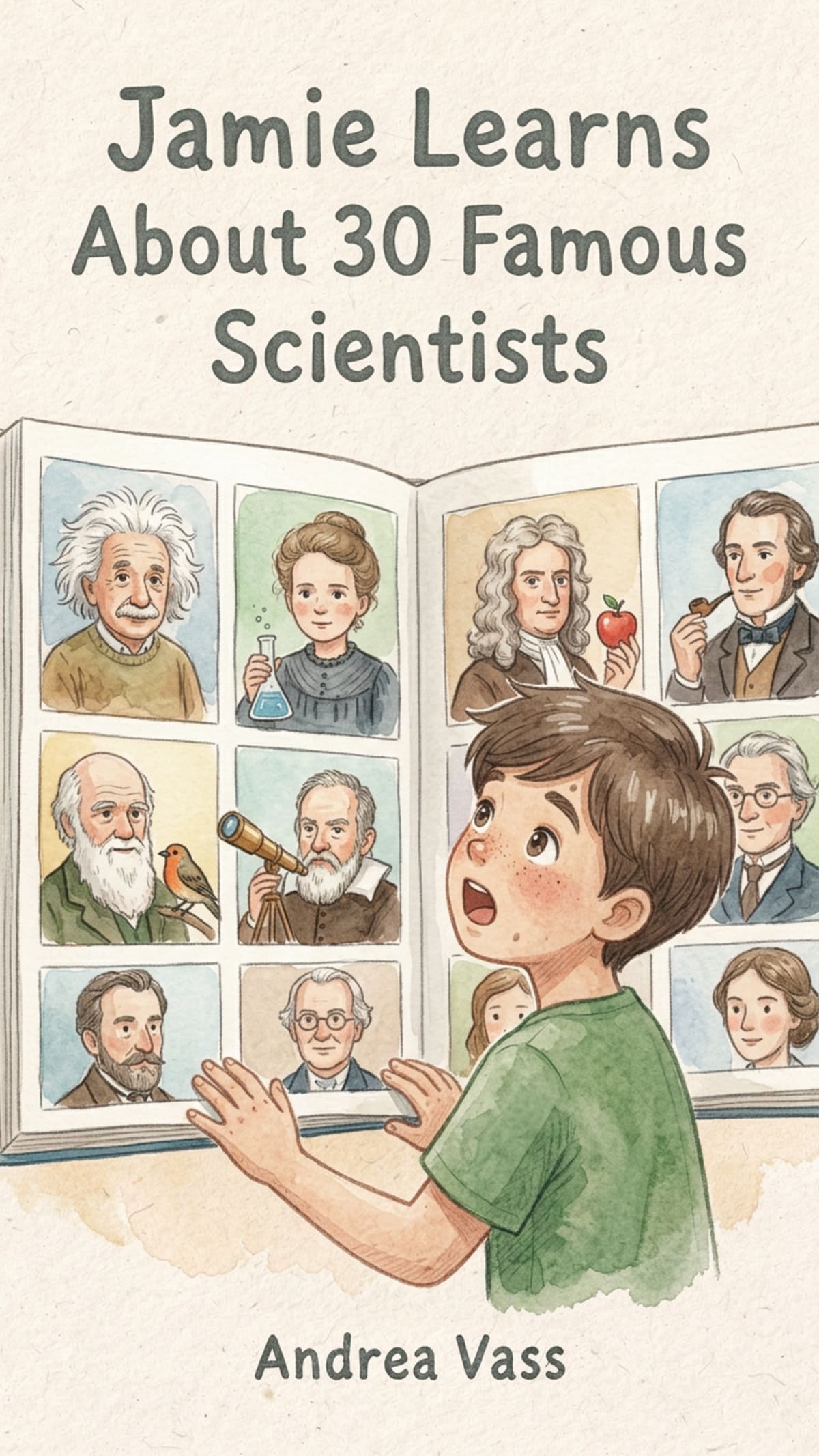
Curiosity is one of the quiet forces that shapes childhood. It’s not loud or dramatic. It doesn’t announce itself. It appears in small moments — when a child stares at a shadow, listens to the wind, or wonders why a compass needle moves even when nothing touches it. My book, Jamie Learns About 30 Famous Scientists, was born from this quiet force.
Jamie, the main character, is not a prodigy or a genius. Jamie is simply a child who looks at the world and wants to understand it. That desire becomes the doorway into thirty lives — thirty scientists whose childhoods were just as full of questions, doubts, fears, and sparks of wonder.
The book begins with Jamie writing a simple sentence in a notebook: “I want to understand the people who changed the world.” That line became the heart of the entire project.
Because children don’t connect to formulas or awards. They connect to people.The Human Side of Genius
When we teach children about Einstein, Newton, Curie, Tesla, or Darwin, we often present them as finished statues — brilliant minds who discovered great things. But every scientist’s story begins long before the discovery. It begins in childhood.
In the book, Einstein is not introduced through relativity. He is introduced as a boy holding a compass, mesmerized by a needle that moves as if guided by an invisible hand. Newton is not introduced through equations, but through raindrops sliding down a window and an apple falling in a quiet orchard. Marie Curie begins not in a laboratory, but in a secret classroom where girls whisper lessons they are forbidden to learn. Tesla begins not with machines, but with thunderstorms that speak to him in flashes of light. Darwin begins not with evolution, but with pockets full of beetles and a curiosity that refuses to sit still.
These childhood moments matter. They show children that great minds were once small, unsure, and wonderfully curious — just like them.Blending Fact With Feeling
The book blends simplified historical facts with gentle fictionalized scenes. This is intentional. Children learn best when they feel something. A cold list of achievements doesn’t inspire them. But a moment of emotion does.
Einstein’s frustration when teachers misunderstand him. Curie studying by candlelight in a freezing attic. Tesla dreaming of inventions while recovering from illness. Darwin standing on the deck of the HMS Beagle, watching the world unfold before him.
These scenes help children understand that science is not distant or mechanical. It is human. It is emotional. It is born from curiosity, struggle, and imagination.Jamie as the Reader’s Mirror
Jamie is not a narrator — Jamie is a companion. A mirror. A guide.
Jamie asks the questions children ask. Jamie wonders the way children wonder. Jamie feels inspired the way children feel inspired.
Jamie doesn’t learn about scientists. Jamie learns from them.
Through Jamie, children discover that curiosity is not just allowed — it is powerful. It is a force that can shape a life, a discovery, or even the world.A Book for Curious Minds
Jamie Learns About 30 Famous Scientists is written for children who love stories, children who love science, and children who don’t love science yet. It is designed for classrooms, bedtime reading, and early learners who want to explore history gently.
The chapters are short, warm, atmospheric, and easy to understand. They introduce complex ideas through emotion rather than jargon. They show children that the world is full of mysteries waiting to be explored — and that every scientist began with a simple question.Why I Wrote This Book
I wrote this book because I believe children deserve stories that show them:
- that curiosity is a strength
- that mistakes are part of learning
- that great people were once small
- that the world is full of wonders waiting to be understood
If even one child finishes the book and whispers, “Maybe I can discover something too…” then Jamie’s journey has already changed the world.